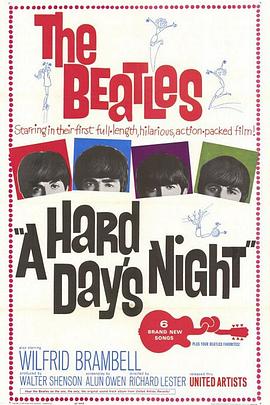
1963年秋天,为了从红透半边天的甲壳虫身上赚笔钱,美国的United Artists和甲壳虫签约拍摄一部电影,目的是得以在美国推出电影的原声唱片。他们找到Walter Shenson做制片,Richard Lester导演,在1964年拍摄了电影A Hard Day's Night。 Shenson在1963年秋甲壳虫前往美国前与他们接触,要求他们为电影创作6首歌——题材不限,但要有两首抒情歌曲,两首快节奏的舞曲等等。在加勒比海度假期间,他们创作了八九首歌,Dick Lester从中选出了六首用于电影中,这些歌曲是:You Can't Do That、And I Love Her、I Should Have Known Better、Tell Me Why、If I Fell、I'm Happy Just to Dance with You。3月2日拍摄开始前,甲壳虫在伦敦EMI录音室里录制了这些歌曲。其中演奏You Can't Do That的部分在电影推出时被剪辑掉了,但之前就做为Can't Buy Me Love单曲的B面发行,也仍然出现在美国版的原声唱片上。 电影拍摄从3月2日开始,至4月24日结束。影片用夸张的手法描述甲壳虫一天的生活,其主题来自John Lennon说过的一句话。当Lester问John他们的瑞典之行如何时,John答道:“It was a room and a car and a car and a room and a room and a car.”这句话稍加变动后被用在电影里,变成了“Paul的爷爷”的台词。 Shenson原先以为他可以随便找一首新歌的歌名作为电影题目,但这六首新歌都不太合适。拍摄期间,大家绞尽脑汁为电影找一个合适的名字。最后有一天,John和他聊天时提起Ringo有趣的语言,并举出“A hard day's night”为例。John自己在刚出版的《In His Own Write》也曾经使用过这个短语。大家一致同意它可以作为电影题目。于是John按Shenson的嘱咐,以此为题创作了电影的主题歌,并在4月16日拍摄电影期间把它录制下来。 美国出版的电影原声唱片只包括这七首新歌,但为了Parlophone的英国唱片,他们在6月回到录音室,又录制了5首新歌 I'll Cry Instead、I'll be Back、Any Time At all、Things We Said Today和 When I Get Home。加上电影里使用的他们之前发行过的单曲Can't Buy Me Love,英国的专辑唱片里一共有13首歌,全部是甲壳虫的原创歌曲。这是他们第一次能够推出一张全部原创的专辑。 这一成就主要应归功于John Lennon当时旺盛的创作力。在这13首歌里,9首都是他主笔创作的。Paul主笔创作了3首歌,并和John合作为George创作了I'm Happy Just to Dance With You。当然,按照主创者主唱的原则,John在这张专辑中的主唱也远远超过其他三人,甚至没有给Ringo一个表现的机会。 A Hard Day's Night的电影成为摇滚电影的经典,教给整整一代年轻人反叛的原则,而这张专辑标志着甲壳虫的创作进入了一个新的阶段,我们可以把它叫做“早期阶段的中期”吧?
A satirical comedy that pokes fun at Spanish social and political stereotypes, featuring parodies of real events and special guest appearances from the political sphere.
7th century Arabia. A time of feuding tribes vying for power and supremacy. Courageous Princess Hind (Aiysha Hart) refuses to serve as concubine to the merciless Sassanid Emperor Kisra (Sir Ben Kingsley). Escaping with her father King Numan into the vast and unforgiving desert, Hind is pursued by Kisra’s mercenary and his bloodthirsty troops. Father and daughter are forced to trust a mysterious bandit (Anthony Mackie). Against all odds, Hind unites the fractious tribes against the powerful invading military of the Sassanid Empire. In an epic showdown, the Battle of Ze Qar will forever change the Arabian Peninsula and echo throughout history.
Fleeing from their violent father, siblings Lucía and Adrián take refuge in a remote mansion. With the help of a hidden micro-camera on a cat, Lucía uncovers a terrifying secret: their neighbors are part of a criminal network that kidnaps teenage girls to make snuff films, and they intend to get rid of the siblings. As Lucía fights to protect her brother, she must face a dark family curse that follows them into their newfound sanctuary.
In 2013, an Australian man a few months shy of turning 60 decided to walk the Camino de Santiago – an 800km pilgrimage trail across the top of Spain. He had no known religion, and absolutely no idea why he felt so deeply compelled to do this torturous walk. But compelled, he was. He completed the walk, battling a “triumvirate of pain” - a knee that he later discovered lacked an...
Calvin Trask lives in a dead end Arctic town on the fringes of society, until mysterious stranger Lucas Wade arrives, turning his solitary life upside down. Calvin's curiosity gets the better of him and is quickly pulled into Lucas' dangerous world. As secrets slowly unravel, Calvin realises just what kind of jeopardy he's put himself in, a place where murder and betrayal are a...
In 2013, an Australian man a few months shy of turning 60 decided to walk the Camino de Santiago – an 800km pilgrimage trail across the top of Spain. He had no known religion, and absolutely no idea why he felt so deeply compelled to do this torturous walk.
But compelled, he was.
He completed the walk, battling a “triumvirate of pain” - a knee that he later discovered lacked any meaningful cartilage, a blister the sight of which would make a grown man weep, and shin-soreness that felt like his lower limb had been split with a mountain axe wielded by a demented troll.
Arriving at the end of the Camino, the majestic cathedral in Santiago de Compostela, he expected an epiphany – an answer to the question he’d been asking himself every day: Why am I doing this?
But no answer came.
So when he got home he wrote a book, hoping the answer would reveal itself in his scribblings. The result was The Way, My Way, a humourous and self-deprecating book that many consider the best memoir ever written on walking the Camino.
The book has now been made into a film, and it’s an extraordinary account of a man at a pivotal point in his life, searching for meaning and finding himself undergoing a fundamental transformation so profound that he now divides his life into “Before the Camino” and “After the Camino.”
It’s a story particular to one man, yet of appeal to anyone seeking a greater meaning from life.
When, at the beginning of Deus Irae, Father Javier stares at a crucifix, his expressions and his hands suggest that the nerves are consuming him. A flashback reveals that this priest devotes his life to visiting families that claim to have seen things that do not belong to this world and cleansing their homes from the demons that try to possess them. But, upon returning to those houses, he notices that the evidence is always destroyed. This way, he discovers that a clan is after him, and must decide whether to hide from them or join them. In times when horror cinema tends to fall into the hands of directors that seek to build narratives that are introspective and close to reality, Pedro Cristiani goes back to old-school horror, where gore and the physical experience are above any other kind of feeling. A cinema that places the camera in front of the faces of the bloodiest demons and, instead of giving logic to them, chooses to face them whatever the cost.